


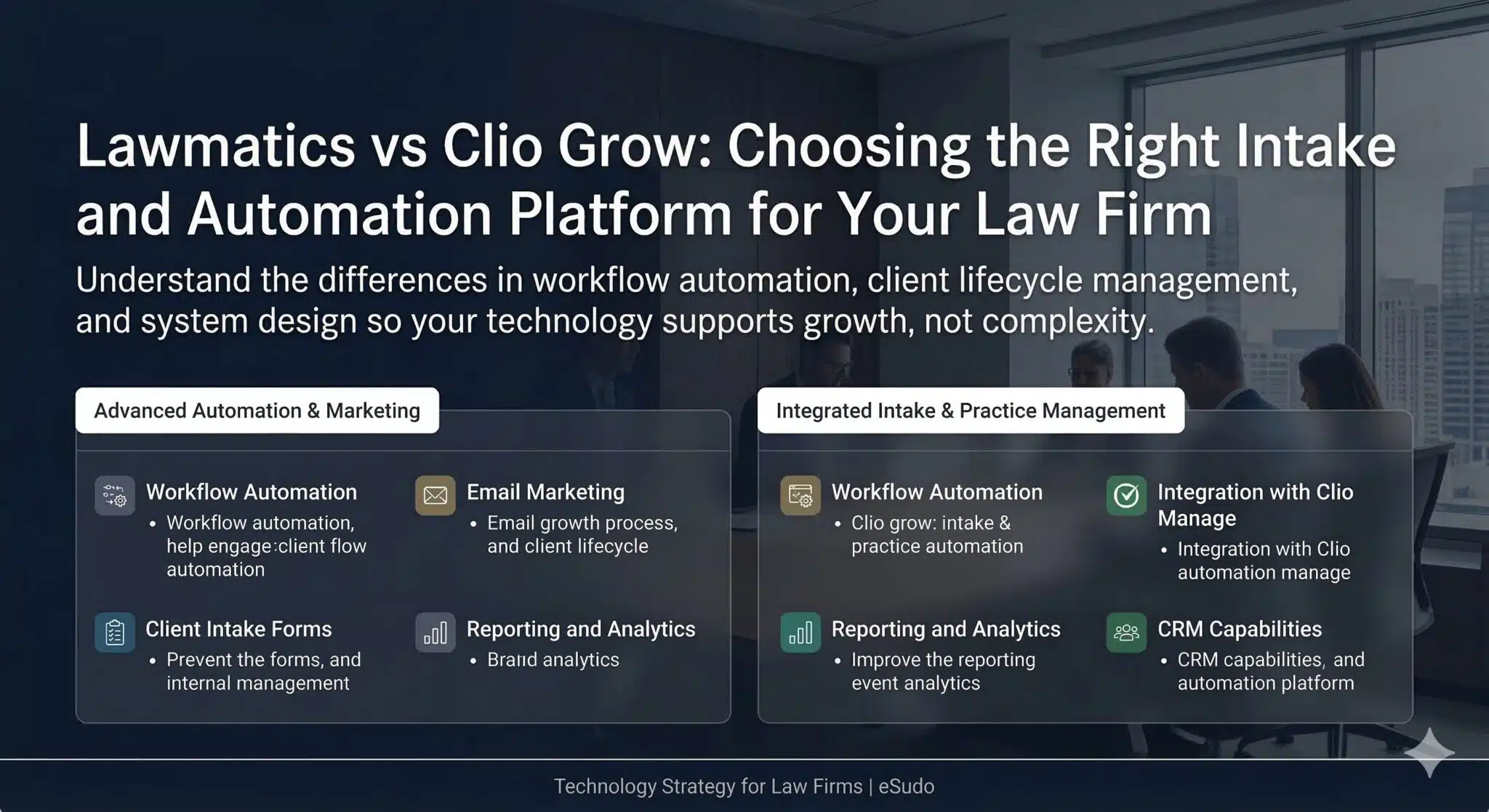
Lawmatics vs. Clio Grow: What Growing Law Firms Need to Know
At eSudo, we work with law firms that want smoother intake, better client communication, and less operational friction. Two platforms come up often: Lawmatics and Clio Grow. Both are useful. Both solve different problems. And both can create frustration when the workflow structure does not match how the firm actually works.
Lawmatics
Better for firms that want more advanced intake automation, client communication, and multi-stage workflows.
Clio Grow
Better for firms that want straightforward intake and a simpler path into the broader Clio ecosystem.
The Real Issue
Most workflow pain is not a software failure. It is usually a system design problem that shows up as the firm grows.
Quick takeaway: If your firm is choosing between Lawmatics and Clio Grow, do not just compare features. Look at how clients return for more work, how matters should be created, where communication history should live, and which system should be your source of truth.
Why this matters for growing law firms
Most firms we speak with want the same thing: a smoother client experience, less manual follow-up, cleaner intake, and better visibility for the team. That is a reasonable goal. The trouble starts when the firm chooses a platform without thinking through the full client lifecycle, the matter structure, and how the systems should work together over time.
In estate planning, immigration, family law, and other structured practices, the software can look great during setup. But when a client returns years later for updates or a new service, the gaps in the original design start to show.
Lawmatics vs. Clio Grow at a glance
Clio Grow
- Simple intake and lead capture
- Pipeline visibility
- Basic automation
- Strong Clio ecosystem alignment
- Best for lower complexity
Lawmatics
- Advanced intake automation
- Multi-stage workflows
- Stronger lifecycle marketing
- More customization
- Best for firms with deeper automation needs
| Capability | Clio Grow | Lawmatics |
|---|---|---|
| Basic intake and lead capture | Yes | Yes |
| Pipeline visibility | Yes | Yes |
| Simple automation | Good | Strong |
| Complex multi-stage workflows | Limited | Advanced |
| Lifecycle marketing | Limited | Strong |
| Native Clio ecosystem alignment | Excellent | Requires integration planning |
| Best fit | Simpler intake and lower complexity | Deeper automation and customization |
What we see most often with Lawmatics
Lawmatics is powerful, especially for firms that want more advanced automation. But a common issue shows up when a client completes one engagement and later returns for another. The firm expects the same workflow to run again. Instead, they discover that the automation does not simply restart the way they expected.
That moment often gets labeled a platform problem. In our view, it is usually not. It is a sign that the workflow was designed more like a continuous client funnel and less like a legal matter structure.
The bigger lesson
Most law firms do not outgrow their software first. They outgrow how their systems were originally designed.
What we recommend instead
When we help law firms think through this, we focus on the architecture behind the workflow:
One client record
Keep the long-term relationship visible in one place, including communications and history.
Separate matter for each engagement
Keep the audit trail, billing logic, and document history clean as new work is opened.
Clear source of truth
Define where intake, matter status, billing, and communication should each live.
Repeatable lifecycle design
Build the system around how clients really return for updates, new services, and follow-up work.
So which one should your firm choose?
Choose Clio Grow when your firm wants simpler intake, tighter alignment with Clio, and less operational complexity.
Choose Lawmatics when your firm wants more advanced automation, more detailed client communication flows, and more flexibility for multi-stage processes.
Either platform can work well. The difference is whether the workflow design, integrations, and matter structure reflect how your firm actually operates today and how it will operate as it grows.
Keep learning: related law firm technology resources
If this topic is relevant to your firm, these next resources will help you think more broadly about legal technology planning, workflow structure, and secure Microsoft 365 adoption.
Law Firm Technology Library
Browse practical articles and guidance for law firm technology, security, operations, and growth.
Law Firm Technology Playbook
See how law firms can align systems, vendors, workflows, and planning.
Microsoft 365 for Law Firms
Learn how Microsoft 365 supports secure collaboration, productivity, and compliance.
Recommended reading path
Start here
Understand the difference between Lawmatics and Clio Grow and why workflow design matters.
Visual resource map
Not sure your systems are structured the right way?
If your law firm is using tools like Lawmatics, Clio, Microsoft 365, or other cloud platforms and your workflows are becoming more complex, it may be time to review the bigger system design. eSudo helps law firms align technology, security, workflow, and vendor coordination so your systems support growth instead of creating operational risk.